

What Types Of Electromagnetic Radiation Makeup Sunlight
Solar Radiation & Photosynthetically Active Radiation
What is Solar Radiations?
Solar radiation is radiant (electromagnetic) energy from the dominicus. Information technology provides calorie-free and heat for the Earth and energy for photosynthesis. This radiant energy is necessary for the metabolism of the environment and its inhabitants i. The three relevant bands, or ranges, along the solar radiation spectrum are ultraviolet, visible (PAR), and infrared. Of the low-cal that reaches Globe'south surface, infrared radiation makes upwardly 49.four% of while visible light provides 42.3% 9. Ultraviolet radiation makes upwards simply over 8% of the total solar radiations. Each of these bands has a different touch on the environment.
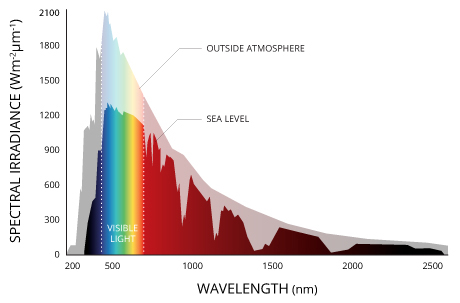
The corporeality and intensity of solar radiations that a location or body of h2o receives depends on a variety of factors. These factors include latitude, season, time of day, deject cover and altitude. Not all radiation emitted from the sunday reaches Earth's surface. Much of it is absorbed, reflected or scattered in the temper. At the surface, solar free energy can be absorbed directly from the sun, called direct radiation, or from light that has been scattered equally information technology enters the atmosphere, called indirect radiation one.
How is Solar Radiation Measured?
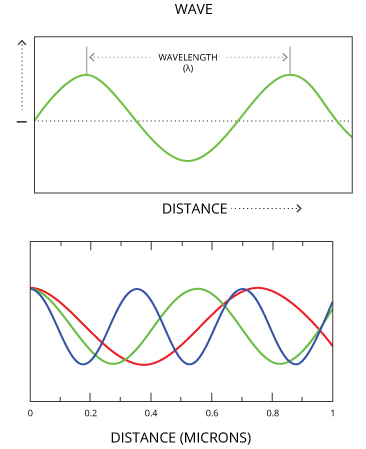
Solar radiation is measured in wavelengths or frequency. As light travels in a wave, a wavelength is defined as the distance from acme to peak and is measured in nanometers (nm). Frequency is defined as wavelength cycles per 2nd and is expressed in hertz (Hz). Bands with shorter wavelengths produce college frequencies. Besides, the longer the wavelength, the longer it volition take to consummate a cycle, which produces a lower frequency one.
The energy of the wavelength increases with the frequency and decreases with the size of the wavelength xvi. In other words, shorter wavelengths are more energetic than longer ones. This means that ultraviolet radiation is more energetic than infrared radiation. Due to this extra energy, shorter wavelengths tend to cause more harm than longer wavelengths 16. The more than energy a wavelength has, the easier it is to disrupt the molecule that absorbs it. Ultraviolet calorie-free (which has the highest energy) can crusade damage to Dna and other important cellular structures sixteen.
What is the Electromagnetic Spectrum?
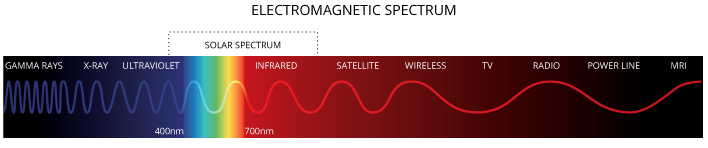
The electromagnetic spectrum encompasses all types of radiations 5. The part of the spectrum that reaches World from the lord's day is betwixt 100 nm and 1 mm. This ring is broken into three ranges: ultraviolet, visible, and infrared radiation. Ultraviolet contains wavelengths between 100-400 nm. Visible light falls inside the range of 400-700 nm, and infrared lite contains wavelengths from 700 nm to over one mm i. In the visible lite spectrum, the colors are determined by the length. Longer wavelengths appear red while shorter wavelengths are bluish/violet every bit they range closer to the ultraviolet spectrum 5.
Ultraviolet Radiation
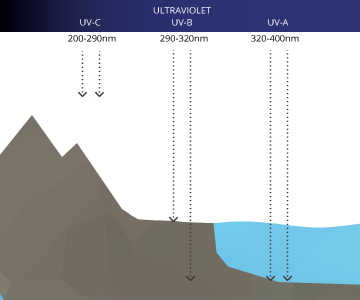
Ultraviolet radiation can be separated into three wavelength ranges: UV-A, UV-B and UV-C. All wavelengths of ultraviolet light can directly impact the DNA of water inhabitants also as generate harmful photochemicals 1. The shorter the wavelength, the more harm information technology is capable of causing.
UV-C includes wavelengths betwixt 100 and 280 nm. This radiations range only makes upwards 0.v% of all solar radiations, only information technology tin can cause the virtually damage to organisms. However, about of this short-moving ridge radiation is captivated past stratospheric gases (ozone), and very little reaches the surface 9.
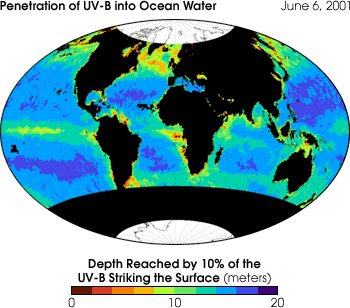
UV-B (280-320 nm) is an energetic, photoactivating band of radiations that is only partially absorbed in the stratosphere one. This radiations band is known for causing skin cancer in humans, and can impair photosynthesis in many plants sixteen. The depth that UV-B penetrates h2o is dependent on turbidity and water chemistry. UV-B will reach greater depths in saline water than in freshwater and can reach as deep as 20m beneath the surface of the body of water i,nine.
UV-A (320-400 nm) has less energy than UV-B, and is non captivated past ozone in the atmosphere. Even so, it can be blocked from the surface by cloud cover 9. UV-A is as well called blacklight, and is known for its ability to cause fluorescence in some materials 37. While information technology is captivated less readily past water, it can penetrate deeper than UV-B or UV-C 1. UV-A is responsible for sunburns in humans. It is also more inhibiting than UV-B in regards to photosynthesis 1. Studies have shown that UV-A tin significantly decrease photosynthesis by more 70% 6. This is considering UV-A decreases the efficiency of electron transport which in plow decreases photosynthetic production.
Ultraviolet Radiation and Phytoplankton
Phytoplankton are microscopic organisms that reside in h2o and use photosynthesis to convert sunlight to energy xvi. These organisms use carbon dioxide and produce oxygen as a photosynthesis byproduct just as plants do 17. Ultraviolet low-cal can stunt this process in phytoplankton. UV-A and UV-B radiations inhibit photosynthetic production, thus reducing carbon dioxide intake and oxygen output. Under natural dominicus-lit atmospheric condition, UV-A and UV-B tin diminish photosynthesis by over eight% 41.
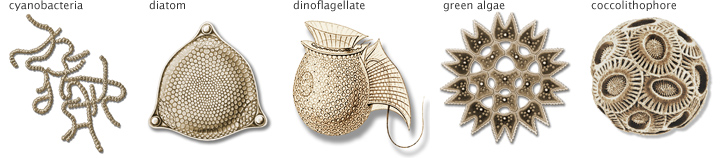
This upshot can be detrimental to more than just phytoplankton. These one-celled plants are responsible for much of the carbon transfer that occurs between the atmosphere and the body of water, a process known as the "biological carbon pump" 17. Much of the bounding main life below the surface depends on phytoplankton, consuming them directly or indirectly 17. Phytoplankton also contribute to "marine snow" – the dead, organic fabric that falls to the ocean floor equally fuel for deep sea organisms. When ultraviolet radiation reduces photosynthetic product of phytoplankton, it negatively affects the world carbon wheel and the marine food chain 16.
Infrared Light
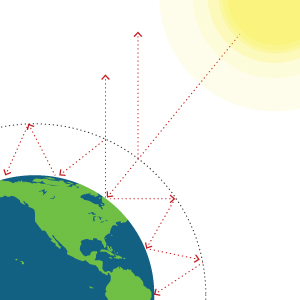
Infrared calorie-free is on the contrary side of the spectrum from ultraviolet light. This radiation has a wavelength of >700 nm and provides 49.four% of solar energy 9. Infrared radiations is readily absorbed past water and carbon dioxide molecules and converted to heat energy x. The longer wavelengths cause heat by heady electrons in the substances that blot them. Thus infrared radiations is responsible for warming World's surface. Infrared lite is reflected more than UV or visible light due to its longer wavelengths 10. This reflection allows infrared radiations to transfer heat between the surface, water and the air.
In a body of water, infrared light tin can only reach a certain distance below the surface. ninety% of infrared radiation is absorbed in the showtime meter of the water's surface, and only i% can reach past ii meters in pure water 1. This is why the surface of most bodies of water are warmer than the depths.
What is Photosynthetically Active Radiations?
Photosynthetically Agile Radiation (PAR) is the light wavelength range that is all-time fit for photosynthesis to occur. Photosynthesis is a process that requires lite energy and optimally occurs in the 400 to 700 nanometer (nm) range ane. This range is also known equally visible light.
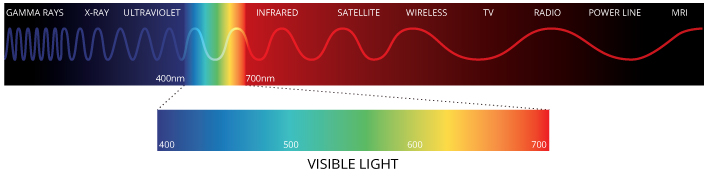
Visible light encompasses the electromagnetic spectrum from visible blue/violet to red. Blue light has a higher energy and shorter wavelength than green or red light. Carmine low-cal has the lowest energy in the visible spectrum 12. As visible light reaches Globe, a surface volition absorb or reverberate different wavelengths, producing a visible colour. The wavelength reflected past a surface is the color that it appears to be 12. If the surface reflects all of the visible wavelengths, information technology volition appear white 12.
About plants appear green as the chlorophyll in their cells reflects green low-cal viii. Water often appears blue equally this color travels the deepest before being captivated 1. While on land, plants use near all of the visible range for photosynthesis. All the same, even underwater when but blue light is bachelor, photosynthesis can all the same occur.
Why are Solar and Photosynthetically Active Radiation Important?
Solar radiations provides estrus, light, and free energy necessary for all living organisms. Infrared radiation supplies heat to all habitats, on land and in the h2o 24. Without solar radiation, Globe'due south surface would be most 32°C colder 25.
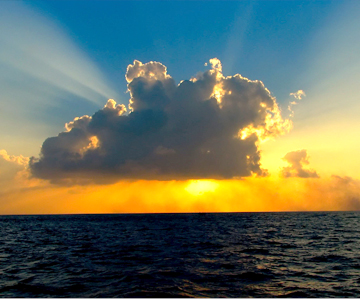
Light is as well provided by solar radiation. Predators would non be able to efficiently hunt prey without light from the sun and casualty would not exist able to take advantage of dark areas if predators were adapted to dark habitats 1. Human eyes are adapted to the visible spectrum, though another species tin can see ultraviolet low-cal in addition to colors 26.
In particular, the level of photosynthetically active radiations (PAR) that an expanse receives is important. This is because different plants respond to unlike wavelengths of PAR 1. About plants reflect greenish wavelengths while absorbing the residual of the visible low-cal spectrum. In improver, shade plants reply to lower levels of PAR while sun plants harvest PAR more efficiently at higher light levels 7. In other words, as solar irradiance (intensity) increases, sun plants feel higher rates of photosynthesis. The leaves of sun plants are small and thick, with special cells allowing for these college rates 20. Shade plants conduct photosynthesis at a lower radiation intensity level. Their leaves are thinner, longer and incorporate fewer chlorophyll cells. This makes information technology easier for photosynthesis to occur in depression light weather 20.
Although the main benefit of photosynthesis is free energy for the plant, it has other of import results. Oxygen is a byproduct of photosynthesis 1. The process ensures that more oxygen is produced than is used upwardly past organisms in the surrounding environment. If photosynthesis does not produce enough dissolved oxygen underwater, it can create anoxic atmospheric condition where fish and other organisms cannot live 1. Photosynthesis also consumes carbon dioxide, thus lowering carbon dioxide levels in air and water i.
Solar Irradiance
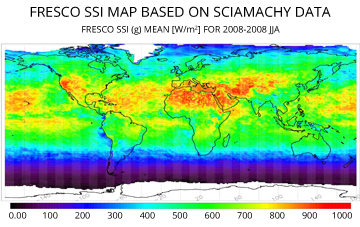
Solar irradiance is the intensity with which radiation enters Earth's atmosphere. An relatable way to recall virtually solar irradiance is past looking at the difference between a 20-watt light bulb and a 100-watt light bulb. Both produce visible light in the aforementioned wavelengths, but the brightness and intensity are very dissimilar. The 100-watt seedling has a higher intensity, or irradiance. Solar irradiance is the corporeality of radiant flux on an area, and is measured in watts per meter squared (W/m²) 9.
What Influences Solar Irradiance?
The solar irradiance received by a particular location or trunk of water depends on the summit above bounding main level, the angle of the sunday (due to latitude, flavour and time of solar day) and scattering elements such as clouds 9. The higher the elevation, the shorter the path from the temper. This tin mean a higher irradiance, though not warmer temperatures. This intense radiation contributes to the arid climates, and the thinner air means more UV radiations reaches the surface at these altitudes.
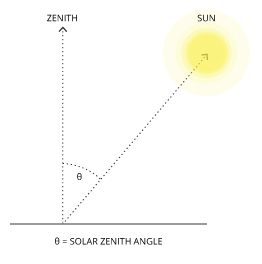
The lower the angle of the sun, the larger corporeality of ozone the light has to pass through 9. This is too factor in ultraviolet irradiance. Ozone absorbs UV low-cal and tin reduce radiations intensity.
The bending of the lord's day is dependent on latitude, time of yr, and fourth dimension of mean solar day. The altitude that radiation has to travel will be at its lowest when the lord's day is straight overhead. This is why the annual net solar irradiance is greater over the equator than over the northern and southern latitudes. Solar irradiance will decrease as a hemisphere is tilted away from the sun.
During the day, the sun'south angle to any given location will subtract from sunrise until noon, and and then increase until sunset. At greater angles (morning and evening) solar radiation has to laissez passer through more of the atmosphere, which reduces its irradiance. This is why sunlight feels less intense in the evening than at noon.
Cloud coverage and air pollution tin can also reduce the corporeality of radiation that reaches World'southward surface. Clouds and aerosols in the temper tin can scatter and absorb all radiation bands nine. As deject cover increases, the angle of the sun becomes less important when measuring irradiance. This is due to the increment of radiations improvidence (scattering) 10. Increased cloud cover decreases irradiance, causing sunlight to feel less intense. On these days solar radiation withal reaches Earth's surface, simply with a lower irradiance. Under these atmospheric condition, humans can go sunburned without realizing the furnishings until it is too late.
Heat, Temperature and Solar Radiation
Sunlight is responsible for warming the Earth, oceans and atmosphere through infrared radiations. Both water and land reflect back some of that radiations to warm the temper or other objects in contact with the surface. The darker the object or surface, the faster information technology volition absorb calorie-free and estrus 31.
Air Temperature
Air temperature is indirectly dependent on solar radiations. While air itself does not absorb infrared radiation, it receives heat from Earth's surface. This outcome occurs through estrus transfer past conduction and convection 31.
World absorbs infrared radiation and converts it to thermal free energy. As the surface absorbs rut from the sun, it becomes warmer than the surrounding atmosphere. The heat is then transferred by conduction (contact) from the warmer World to the cooler atmosphere 24. Air itself is a poor conductor of heat, so convection, or the rise and fall of warm and cool air, warms the residue of the atmosphere not in contact with the surface 31. The rising warm air is oft referred to as a thermal. As the warmed air rises, libation air sinks to the surface, where it continues in the convection procedure.
Earth'southward surface too reflects some infrared radiation back into the air. This reflected radiation can be trapped and absorbed by gases in the atmosphere, or re-radiated dorsum to the Earth 25. This process is called the greenhouse effect. Without the greenhouse effect, the World'due south boilerplate surface temperature would be well-nigh-18°C instead of the current +18°C 25.
H2o Temperature
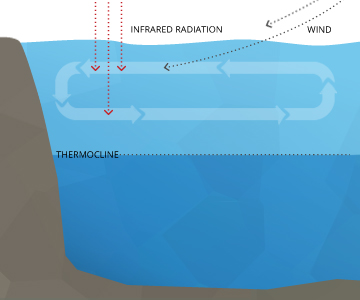
Infrared light from the sun is captivated by bodies of water and converted to heat energy. This low free energy radiations excites electrons and warms the top layer of h2o. Well-nigh all infrared radiation is absorbed within ane meter of the surface 1. This oestrus is and then transferred to greater depths through move from current of air and convection ane. While rut is slowly transferred throughout the h2o column, information technology oftentimes does non achieve all the way to the bottom. This is due to water cavalcade stratification.
In the ocean and many lakes, water can stratify, or form distinct layers of h2o. These layers are distinguished by their temperatures, densities and often different concentrations of dissolved substances (such equally salt or oxygen). The dissimilar water strata are separated by steep temperature gradients known as thermoclines one. Even with convection and air current, it is difficult for most of the sun's rut to cross these barriers. Instead, the everyman strata of water volition remain about four°C, while the surface h2o temperature will fluctuate both diurnally (daily) and seasonally 1.
What is Photosynthesis?
Photosynthesis is the process by which plants and other organisms, also known every bit photoautotrophs, utilise free energy from sunlight to produce glucose. This process can occur both on country and underwater 18.
Glucose is a kind of sugar that is later converted into Adenosine Triphosphate (ATP) via cellular respiration 3. ATP is an energy-begetting molecule that is used in the metabolic reactions of living organisms. This molecule is a necessity in almost all organisms iv. Photoautotrophs use sunlight, six carbon dioxide molecules, and twelve h2o molecules to produce one molecule of glucose, half dozen oxygen molecules, and half-dozen water molecules. This reaction reduces carbon dioxide levels in the air or h2o while producing glucose for ATP.
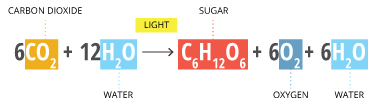
Photosynthesis can occur underwater as long as enough light is available. In the body of water, significant amounts of photosynthetically active radiations tin can be detected as deep as 200 thousand below the surface 29. Within this euphotic zone (sunlight zone), photosynthesis tin can occur. This procedure only requires lite, carbon dioxide, and water 18. Every bit long as a photosynthesizing organism, on land or underwater, has plenty of these molecules, it can produce glucose and oxygen.
Photosynthesis and Temperature
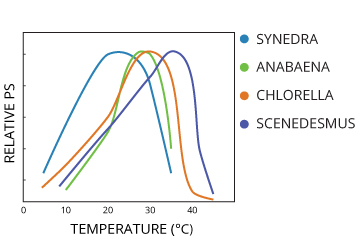
Photosynthesis is a series of chemical reactions that occur with the help of enzymes. Enzymes are catalysts in biological processes and assistance speed up chemical reactions 11. Photosynthesis also requires oestrus to actuate the process. Every bit rut increases kinetic energy (causing reactants to bump into one some other more frequently), a higher temperature tin can speed up chemical reactions in addition to initiating the process eleven.
Although increased temperatures can speed upwardly photosynthesis, too much rut can be detrimental 11. At a certain temperature, enzymes become denatured and lose their shapes. Denatured enzymes no longer speed up chemic reactions and instead slow down photosynthesis. Thus temperature is an important factor in photosynthetic production, both in activating and maintaining the process. This is why there are different optimal temperatures for photosynthesis for different organisms ane.
How is Underwater Photosynthesis Affected past Turbidity?
Turbidity is a lack of water clarity caused by the presence of suspended particles 1. These particles absorb sunlight and tin can crusade low-cal to be reflected off the particles in h2o. The more than particles present in the water, the less photosynthetically agile radiations that will be received by plants and phytoplankton. This loss of sunlight decreases the rate of photosynthesis. If the photosynthetic product is express, the dissolved oxygen level in the h2o will decrease xiii. In add-on, turbidity can crusade meaning damage to water habitats past arresting infrared radiation and increasing h2o temperature higher up normal levels.
Why tin't Photosynthesis utilize UV or Infrared Light?
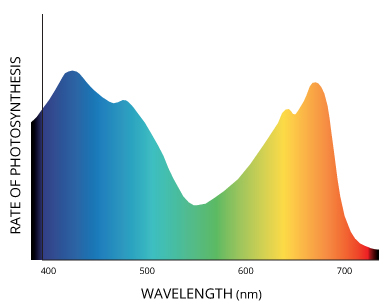
Visible light is the only ring of low-cal on the spectrum to be considered photosynthetically active. Information technology has the perfect amount of energy to excite the electrons needed to start photosynthesis and not harm DNA or suspension bonds.
Ultraviolet can not be used for photosynthesis because it has too much energy. This energy breaks the bonds in molecules and can destroy DNA and other important structures in organisms eight. When plants and other photoautotrophs attempt to use UV-A (320-400 nm) for photosynthesis, electron transport efficiency is decreased, which in turn decreases the charge per unit of photosynthesis vi. On the other side of the spectrum, infrared light does not comprise much energy. The insufficient energy does not excite electrons in molecules enough to be used for photosynthesis. Infrared lite is converted to thermal energy instead 8.
Typical Solar Radiations Levels
Solar radiation levels are dependent on the time of day and on the dominicus's angle toward Globe. This angle volition vary by latitude and season. The greater the angle of the sun, the more ozone that sunlight must pass through to reach the surface 9. In improver to the sun's angle, atmospheric conditions can affect radiations levels. Cloud embrace, air pollution and the hole in the ozone layer all alter the amount of solar radiation that can attain the surface. These factors all cause typical radiations levels to differ.
Daily Fluctuations
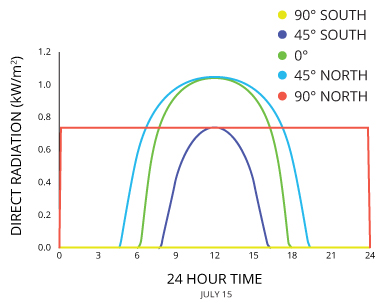
Over almost of Earth's surface, the solar radiation received is measured by the solar irradiance. The irradiance will increase from sunrise until noon, and and then decrease until sunset 36. Meridian solar energy levels received will vary by breadth and flavor 15.
Every bit seen on the graph to the left, the equator has the steepest solar radiation curve, giving it the shortest sunrise and sunset periods. In improver, the length of mean solar day does not vary greatly throughout the year. This occurs because the angle of the dominicus does not significantly fluctuate over the equator.
A hemisphere tilted toward the sunday would reach a similar acme radiation level equally the equator, but with more than gradual curves, meaning longer sunrises and sunsets. This hemisphere would likewise accept longer days overall. The opposing hemisphere (tilted away from the sun) would take shorter sunrises and sunsets, likewise as shorter periods of daylight xv.
At the geographic North and South Poles (90° latitude), solar irradiance seems to stay constant throughout a single day xv. This is because the poles are the Earth's rotating point. Although the daily values do non appear to change, the level of solar radiations received at the poles will slowly shift throughout the year.
Monthly Fluctuations
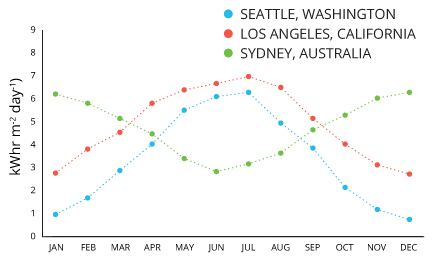
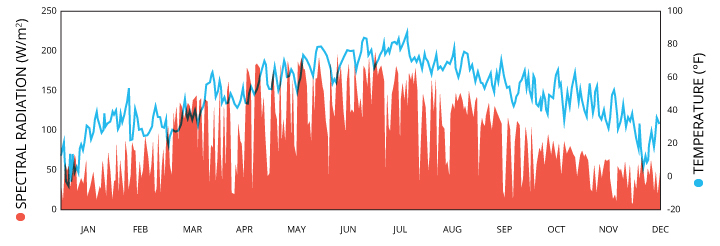
Solar radiations levels depend on proximity to the lord's day and the sun's angle. Thus unlike areas of the earth have different typical radiation levels in each season. At the equator, the typical solar radiation is fairly constant year round fifteen. In that location are slight fluctuations only no drastic spikes or drops. In the Northern Hemisphere, the radiation increases every bit the twelvemonth progresses until it peaks around June or July. The radiations levels then slowly decrease throughout the rest of the year 14. In the Southern Hemisphere, the radiation levels are contrary. At the first of the year, levels are high and then slowly drop to their everyman point around June. Afterwards June, they begin to ascension again for the remainder of the year 14.
The Hole in the Ozone Layer
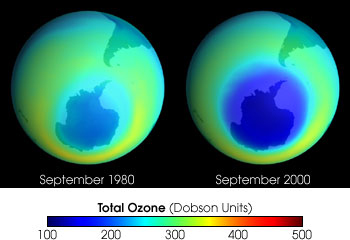
Ozone is a molecular gas composed of three oxygen atoms (O3). This gas helps protect Earth because it absorbs most of the lord's day's ultraviolet radiation. The bulk of UV-C, virtually of UV-B and almost half of UV-A are captivated by oxygen and ozone in the ozone layer. This layer is primarily constitute in the stratosphere, between x and 50 km higher up Earth's surface.
The "hole in the ozone layer" is institute in the atmosphere over the Antarctic. This expanse is not completely void of ozone, but is instead a patch of atmosphere that possesses a significantly lower level of ozone than normal 27. While the cause of gap is sometimes a subject of debate, studies have shown that ozone is destroyed when it reacts with chlorine, nitrogen, hydrogen, or bromine 27. When these chemicals enter the temper, they tin can remove the ozone present. Regardless of its cause, the hole in the ozone layer allows more UV radiation to reach Globe. If the increase in UV radiation becomes excessive, it tin be harmful to both terrestrial and aqueous habitats 27.
Consequences of Unusual Levels
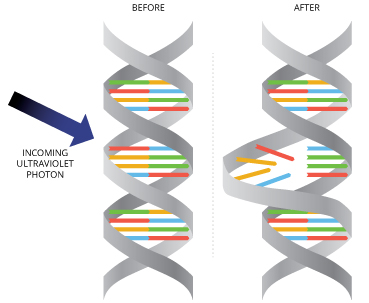
Unusually high or low levels of sunlight can crusade problems for both country and water habitats. As well much ultraviolet light can cause irreversible damage to Deoxyribonucleic acid and important photosynthetic structures, while besides much infrared low-cal tin cause overheating ane. DNA damage is acquired by UV-B radiation. While virtually living cells accept adapted and can repair simple damage, increased exposure to UV radiation tin crusade cells to mutate beyond repair, or to die sixteen.
On cloudy days, or if a previously sunny location becomes shaded, photosynthetic production can be halted. Not merely does this stop oxygen product, but it increases oxygen consumption through plant respiration ane. The decrease in infrared light will also cool the shaded surface or body of water, which in turns cools the surrounding air.
Water
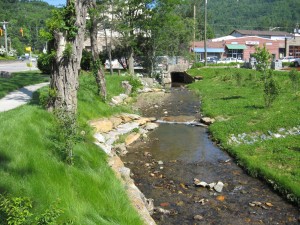
When h2o is exposed to excessive amounts of sunlight, the infrared radiation will heat the water. The warmer a body water is, the faster the rate of evaporation will be. This tin reduce water levels and water flow. In improver, warm water can not hold equally much dissolved oxygen as common cold water. This ways that in warmer water, less dissolved oxygen is available for aquatic organisms 21. Too much infrared light can also cause the enzymes used in photosynthesis to denature, which can ho-hum or halt the photosynthetic process eleven.
On the other side of the spectrum, radiation can be limited by cloudy days, shade sources or low lord's day angles. If radiation from the sunday is lower than usual for an extended period of fourth dimension, photosynthetic production can decrease or be stopped completely. Without sunlight, phytoplankton and plants volition consume oxygen instead of producing it. These atmospheric condition can crusade dissolved oxygen levels in the water to plummet, potentially causing a fish kill xx.
Land

As in h2o, terrestrial radiation levels can be limited by cloudy weather condition 20. This is particularly important to plants, as the photosynthetic process and plant physiology in general are dependent on sunlight.
Stomata are pores found on the outer layer of constitute leaves. They open in the presence of sunlight and permit h2o, carbon dioxide, and oxygen to enter the plant 22. These molecules are so used to produce glucose through photosynthesis. On common cold, sunless days, stomata shut because not enough energy from the sun is beingness received to continue photosynthesis 23. Too much intense sunlight tin can also halt the product of photosynthesis, every bit stomata will close on sunny, hot and dry days to foreclose water loss 23.
Sunlight tin can affect more than the opening and closing of plant stomata. While some plants take specialized proteins that protect them from sunburn, others do non, and intense solar radiation tin can damage their leaves 32. Plants that are not adapted to total or intense sunlight, such as hostas or rhododendrons, can develop oestrus stress. Many plants, including shade plants, are susceptible to leaf scorch, where parts of the found dice due to excessive water loss through transpiration 33. In addition to slowing or halting photosynthesis, heat stress and leaf scorch can make plants more susceptible to disease or insect infestations.
How Much Light?
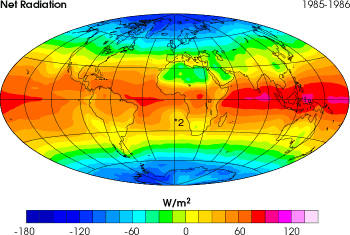
How much calorie-free does the sunday produce? This is a complex question to answer every bit in that location are different ways to consider and measure light. There is radiance (projected ability) and visible light, which can be measured every bit luminance (brightness) or illuminance (incident low-cal). Luminance and illuminance apply only to the wavelengths in the visible light band37. Sunlight is usually defined in radiance units, as only half of the solar radiation that reaches Earth is visible lite, but all of the radiation provides free energy.
Radiant energy can be measured in joules, though information technology is more ordinarily measured as radiant flux, or radiant power, which is expressed every bit energy over time. The bones unit of ability is the watt (joules/second). The sun emits 384,600,000,000,000,000,000,000,000 watts (3.846 10 x26 Westward) 38. For comparison, the average incandescent light bulb consumes xl-100 watts. This energy is projected out from the sun in a sphere, where some volition fall on Earth. The energy that reaches Earth is measured as solar irradiance (energy per second over a foursquare meter). Given the estimated radiant power of the sunday, the intensity of solar energy that reaches the top of Earth'due south atmosphere (direct facing the sun) is 1,360 W/m² 39.
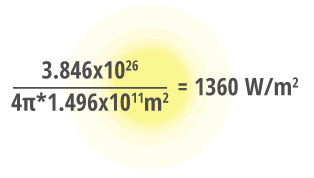
The amount of irradiance that reaches the surface can vary due to Earth's elliptical orbit, solar flares and the amount of atmosphere the radiation must pass through (due to the lord's day's angle to the surface or deject encompass present).
What does that hateful in terms of visible calorie-free? Luminance and illuminance attempt to define the brightness and the light projected from a given source. A lumen is the standard measure out of visible "effulgence" every bit seen by the human being eye 37. Lumens can only exist measured over the photosynthetically active radiations ring, or the range of visible lite. One lumen of light over i square meter is one lux (lm/g^2), which is the the SI unit of measurement for illuminance. In directly sunlight, when the sun is at its zenith (directly overhead), measured lux could be as high equally 130,000 xl. On most sunny days (out of direct light), illuminance is ordinarily ten,000-25,000 lux. On an overcast day, incident calorie-free may merely reach one thousand lux, and at twilight information technology may be 10 lux 40. The greater the angle of the sun, the lower the lux volition exist, every bit the lumens are spread out over a greater area. Illuminance is important to consider when evaluating photosynthetically active radiations.
How much light actually reaches the Earth's surface?
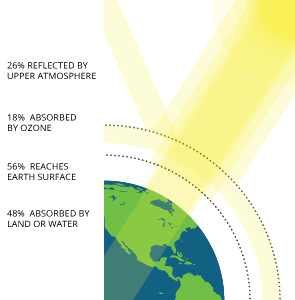
The sun'south radiation must make it through multiple barriers before it reaches Earth's surface. The first barrier is the atmosphere. About 26% of the sun's energy is reflected or scattered back into space by clouds and particulates in the atmosphere 34. Another eighteen% of solar energy is absorbed in the atmosphere. Ozone absorbs ultraviolet radiation, while carbon dioxide and water vapor tin absorb infrared radiations 34. The remaining 56% of solar radiation is able to reach the surface. However, some of this light is reflected off of snowfall or other bright basis surfaces, so only 48% is bachelor to be absorbed by land or water 36. Of the radiations that reaches the surface, approximately half is visible calorie-free and half is infrared light one. These reflection and absorption percentages can vary due to cloud comprehend and sun angle. In cloudy weather, up to 70% of solar radiation can be absorbed or scattered by the atmosphere 35.
How much light breaks the surface of the water?
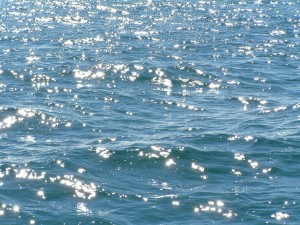
Once the light reaches the surface of the water, reflection and scattering can occur. Reflection occurs when solar radiation just bounces off the water 1. This reflection is due to water's albedo, or reflectivity. The amount of sunlight reflected depends on the sun'south bending, wavelength, and weather conditions. Of the lite that reaches the water'south surface, approximately 5-10% is reflected 1. Longer wavelengths are reflected slightly more than shorter wavelengths 10.
Handful is the deflection of calorie-free by molecules in the water. Dissimilar materials, including dissolved and suspended solids, as well as organisms in the water, cause light to besprinkle in unlike directions i. The corporeality of low-cal that scatters is dependent on the clarity of the h2o.
How deep does sunlight reach in the sea?
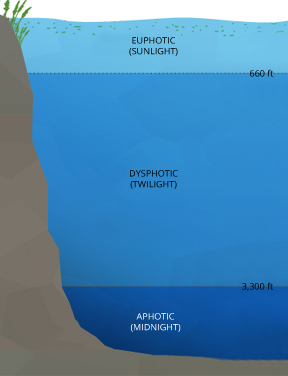
The ocean is split into iii zones based on light. The first zone, the euphotic or sunlight zone, is where sunlight penetrates. Phytoplankton live in the euphotic zone because there is enough light for photosynthesis. This zone extends to most 660 ft below the ocean surface. 2
The next zone is called the dysphotic (twilight) zone. Some light is able to reach this depth, but it is not plenty for photosynthesis to occur 29.
The last zone starts near three,300 ft below the body of water's surface and is chosen the aphotic (midnight) zone. Sunlight cannot attain this zone, and its but light comes from bioluminescent organisms ii.
How deep does sunlight accomplish in freshwater?
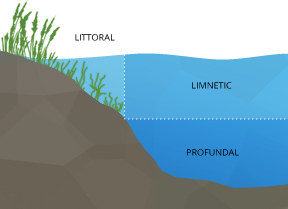
The depth that light penetrates in freshwater is dependent on water clarity. In waters with a high level of turbidity, or suspended solids, light will not reach as far as clear bodies of water. These suspended particles can both blot and scatter low-cal i. In about rivers and streams, light will achieve the riverbed, and photosynthesis can occur throughout the water cavalcade. However, in particularly deep, algae-covered or turbid lakes, light may non be able to accomplish certain depths.
Like the body of water, deep lakes are split up into three zones. The first zone is called the littoral zone. This zone is close to the shore and sunlight reaches all the way to the bottom. Aquatic plants in the littoral zone tin abound on the lake bed and still receive plenty low-cal for photosynthesis 19. The adjacent zone is known as the limnetic zone and is the surface layer of open water. Photosynthesis tin can occur in this zone equally it is penetrated past light. The depth of the limnetic zone depends on the turbidity of the water. In more turbid h2o, the limnetic zone volition be shallower nineteen. Below the limnetic zone is the profundal zone. This is the benthic (lesser) layer of a deep lake. Sunlight cannot accomplish this zone, so photosynthesis will not occur. Instead, organisms that permanently reside in the profundal zone (such as bacteria) rely on falling organic matter from higher zones 19.
Calorie-free Transmission Through Water ice and Snow
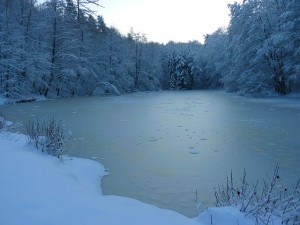
The amount of light absorbed in a body of water tin can be profoundly affected by ice and snow encompass. Clear, colorless water ice has the same percentage of low-cal transmission equally liquid h2o, which is about 72% ane. Even so, if the ice is stained or cloudy, the percentage can drop dramatically. Opaque ice and heavy snow tin can drop the per centum of lite manual to nearly zilch. If a body of h2o is covered in ice and snow for a long menstruum of time, its entire metabolism can be stunted.
Photosynthesis, which requires light, produces oxygen every bit a byproduct and helps maintain dissolved oxygen levels in a torso of water. Dissolved oxygen is continuously consumed in metabolic reactions past living organisms in the water, regardless of snowfall and ice cover. If snow and ice preclude photosynthesis, plant respiration volition contribute to the oxygen depletion instead of restoring dissolved oxygen levels. When this occurs, oxygen reduction, or anoxia, tin result and many organisms can dice. This frequently occurs in shallow, productive lakes and ponds and is known every bit a winterkill 1.
Aquatic Organisms and Visible Low-cal
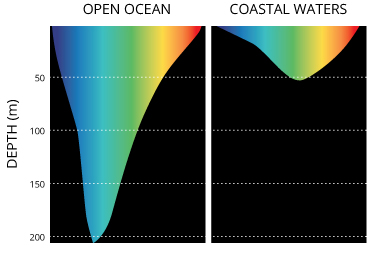
Sunlight can only accomplish sure depths in h2o 29. Beyond 200 m, there is non plenty light for photosynthesis to occur. The homo eye is not sensitive enough to discover sunlight under 850 m of water 26. Fifty-fifty the most visually-adapted fish can not see light from the sun at depths below yard one thousand. However, many of the organisms that live at or below this depth still have functioning eyes. Instead of relying on sunlight, they use their ain bioluminescence for light 26.
Fish that alive near the surface accept similar visual abilities to those of organisms on country. They possess color vision considering the visible light spectrum penetrates the surface of water26. Many fish are also equipped with UV vision, giving them an opportunity to see animals that are transparent in visible light 26.
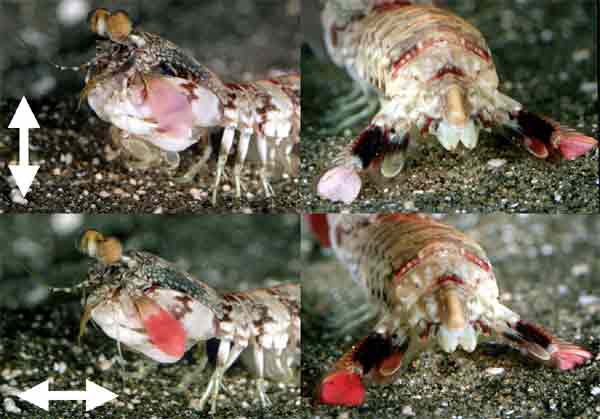
Species like shrimp and squid can encounter the polarization of underwater light in add-on possessing colour and UV vision. With this ability, they can efficiently locate prey as the polarization of light is contradistinct when it bounces off scales 26. Mantis shrimp may also apply this ability for mating, equally the male's paddles modify colour with a unlike polarized orientation xxx.
Cite This Work
Fondriest Environmental, Inc. "Solar Radiation and Photosynethically Active Radiations." Fundamentals of Ecology Measurements. 21 Mar. 2014. Web. < https://www.fondriest.com/ecology-measurements/parameters/weather/solar-radiation/ >.
Additional Information
- Measurement Methods
- PAR Sensors
- Underwater PAR Sensors
- Applications
- References
Source: https://www.fondriest.com/environmental-measurements/parameters/weather/photosynthetically-active-radiation/
Posted by: whanghattertion58.blogspot.com
0 Response to "What Types Of Electromagnetic Radiation Makeup Sunlight"
Post a Comment